
The ICT Fair Value Gap (FVG): A Complete Guide
The ICT Fair Value Gap, or FVG, is a three-candle pattern that leaves behind an un-retraced area between the high of the first candle and the low of the third. Out of everything ICT teaches, the FVG is probably the cleanest, most straightforward concept to grasp — and once it clicks, ideas like inducement, order blocks, displacement and order flow all start building naturally on top of it.
An FVG is basically a marker of imbalance, and it ends up acting as a support or resistance zone on the chart.
In this guide I’ll walk through the whole concept — what it means, the bullish and bearish versions, a 6-step method for spotting one, the exact trade flow I use, the wider FVG family (regular, inversion, implied, balanced, breakaway, NWOG, NDOG), the mistakes people commonly make, and a full FAQ section at the end.
What is ICT FVG (Fair Value Gap)?
An ICT fair value gap is a three-candle structure where a gap forms between the high of the first candle and the low of the third.
That gap exists because price never came back to fill it — it just left it open and kept moving.
Think of the FVG as a magnet — price tends to come back and retrace into it to “balance” the delivery, and once it’s tested, price usually reverses and carries on with the original trend.
How to Identify an ICT Fair Value Gap
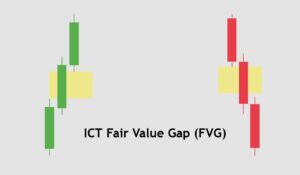
Start by finding a large candlestick — one with a big body and not much wick.
Once you’ve spotted it, mark the high of the candle right before it, and the low of the candle right after it.
Between those two points, you’ll see a visible gap — that’s your fair value gap.
Types of ICT FVG
Based on the direction of the move, there are two main types — bullish and bearish.
Bullish Fair Value Gap
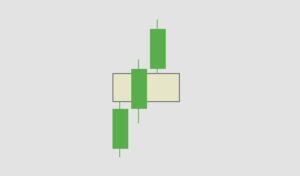
A bullish FVG shows up during an uptrend as part of a three-candle sequence.
It forms when the middle candle has a big body, which leaves a gap between the high of the first candle and the low of the third.
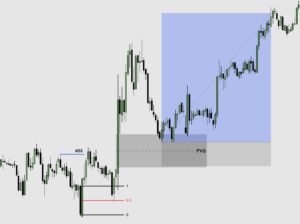
In an uptrend, this gap often acts as solid support — price dips back to fill it before continuing higher.
Bearish Fair Value Gap
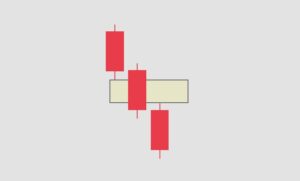
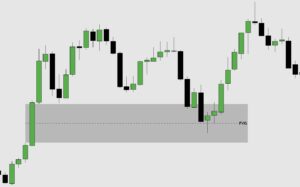
A bearish FVG appears in a downtrend, again as a three-candle formation.
Here, the middle candle’s large body creates a gap between the low of the first candle and the high of the third.
In a downtrend, this gap tends to work as resistance — price usually comes back up to fill it before dropping again.
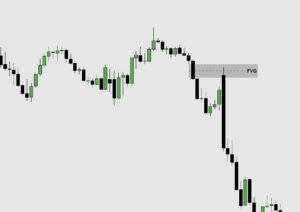
ICT FVG Trading Strategy
Here’s the process I follow to trade off an FVG:
Step 1 — Figure out the trend. Work out whether the asset is bullish or bearish. Daily Bias helps here. In a bullish trend you’ll see higher highs and higher lows; in a bearish one, lower lows and lower highs.
Step 2 — Spot the premium/discount zone. In a bearish trend, you’re looking for the premium FVG. In a bullish trend, the discount FVG.
Step 3 — Find the large candle. Once the trend is clear, look for a candle with a big body and small wicks — a strong bullish candle in an uptrend, a strong bearish one in a downtrend.
Step 4 — Check the candles around it. Look at the candle right before it and right after it. Their bodies shouldn’t overlap with the middle candle’s body — that confirms a real gap between the wicks of candle one and candle three.
Step 5 — Mark the gap. In a bullish trend, mark between the high of candle one and the low of candle three. In a bearish trend, mark between the low of candle one and the high of candle three.
Step 6 — Take the trade. In a bullish trend, wait for price to pull back into the discount FVG, then look for a buy — ideally backed by a rejection or a structure shift on the lower timeframe. In a bearish trend, wait for price to rally into the premium FVG, and look for a sell with the same kind of confirmation.
The FVG Family — Variants You Should Know
The fair value gap isn’t a single, isolated idea — there’s a whole family of related concepts that build on it:
- First Presented FVG — the very first FVG of the day or session, often the cleanest one inside the daily Power-of-3 template.
- Valid FVG — one that passes the validity check: no overlapping wicks, enough displacement, and aligned with bias.
- Inversion FVG (iFVG) — an FVG that gets broken the opposite way and flips polarity, now working as support/resistance in the other direction.
- Implied FVG — a structural gap implied by the wicks of three candles, even if the bodies overlap.
- Balanced Price Range (BPR) — where two opposite-direction FVGs overlap in the same zone.
- Breakaway Gap — an FVG price never comes back to, protected by a breaker block, iFVG, or BPR sitting in front of it.
- NWOG — the weekend gap between Friday’s close and Monday’s open.
- NDOG — the daily gap between the 5 PM close and 6 PM open, New York time.
- SIBI / BISI — the naming convention used for sell-side and buy-side FVGs.
Step-by-Step FVG Trade Flow
This is the exact sequence I run through on every FVG trade.
- Get the higher-timeframe context first — daily and 4-hour, and whether structure is bullish, bearish, or neutral.
- Work out premium vs discount. Bullish bias means you’re hunting discount FVGs; bearish bias means premium FVGs.
- Mark the FVG that matches your bias — the three-candle gap between the first and third candle’s wicks.
- Wait for price to retrace into it. Bullish setup: price drops into the discount FVG. Bearish setup: price rallies into the premium FVG.
- Drop down to a lower timeframe — 5-minute or 15-minute — for your actual entry trigger.
- Wait for a Market Structure Shift on the lower timeframe right at the FVG — a clean break of the last counter-trend swing point.
- Enter after that MSS, either at the 50% midpoint of the FVG (consequent encroachment) or right at the edge of the gap (IOFED).
- Place your stop beyond the far edge of the FVG, or beyond the MSS swing extreme, with a small buffer.
- Take profit at the next liquidity draw — an old high or low, an equal level, or a higher-timeframe FVG.
Best Timeframe for ICT FVG Identification
The FVG works differently depending on the timeframe. On the daily, it helps set your overall bias. On the 4-hour, it acts as a higher-timeframe PD Array. On the 15-minute or 5-minute, it’s where you’ll find your actual entries.
If you’re using the FVG purely to find entries, stick to the 15-minute chart or lower.
Best Pairs for ICT FVG Trading
ICT originally introduced the fair value gap using index charts — Nasdaq and the S&P 500 — and that’s where it worked best initially. Later on, he showed it working just as well across forex pairs.
These days it’s used across the board — currencies, indices, metals, and even crypto.
For traders in the US working under CFTC FIFO and no-hedge rules, the FVG framework fits cleanly with NQ and ES futures on the CME, along with regulated forex pairs through US brokers. The 9:50 AM New York macro window and the 10–11 AM Silver Bullet window tend to be the strongest times to look for FVG entries.
Common Mistakes Around the Fair Value Gap
Here are the mistakes I see most often when people are new to trading the FVG:
- Treating every gap as tradeable. Not every imbalance is worth trading — it needs to be aligned with bias, sitting in the premium/discount of the higher-timeframe range, and backed by a lower-timeframe MSS.
- Marking FVGs inside choppy ranges. FVGs work best inside a clear directional move. In a range, every little pullback creates noise gaps that price just ignores.
- Jumping in without confirmation. The FVG marks the zone — it’s not the entry signal by itself. You still need the lower-timeframe MSS or an order block forming at that zone.
- Mixing up regular and inversion FVGs. A regular FVG holds in the direction of the original move. An inversion FVG flips once it’s broken. Confusing the two flips your entire trade direction.
- Putting stops right at the FVG edge. Tight stops at the boundary get picked off on the second test. Give it a buffer beyond the far edge, or beyond the MSS swing extreme.
- Trading FVGs against the higher-timeframe bias. An FVG that matches the higher-timeframe trend has a noticeably better success rate than one going against it.
FAQs about ICT Fair Value Gap
What is an ICT Fair Value Gap? A three-candle formation with an un-retraced area between the high and low of the first and third candles. It signals imbalance and acts as a support/resistance zone that price usually revisits before continuing in the original direction.
How do I identify a fair value gap? Find a large-bodied candle, then mark the high of the candle before it and the low of the candle after it. The gap between those two points is the FVG.
What’s the difference between a bullish and bearish FVG? Bullish forms in an uptrend, with the gap between the high of candle one and the low of candle three, acting as support. Bearish forms in a downtrend, with the gap between the low of candle one and the high of candle three, acting as resistance.
What is the consequent encroachment of an FVG? It’s the 50% midpoint of the gap — often the most reactive point inside it, and commonly used as a more refined entry.
What is the IOFED of an FVG? IOFED stands for Institutional Order Flow Entry Drill — the very earliest entry point at the edge of the gap. For bullish, it’s just inside the low of the third candle; for bearish, just inside the high of the third candle.
Where should I place my stop loss on an FVG trade? Beyond the far edge of the FVG, or beyond the lower-timeframe MSS swing extreme — with a small buffer. Not right at the boundary of the gap.
Where do I take profit? At the next liquidity draw — an old high or low, an equal level, or the next higher-timeframe PD Array.
What’s the best timeframe for FVG trading? Mark the higher-timeframe FVG on the daily or 4-hour for bias, then use the 15-minute or 5-minute for your entry trigger. The 1-minute can work for very tight scalps.
Does the FVG work on indices and gold? Yes — NQ, ES, and XAU/USD all produce solid FVG setups, especially during the New York AM session and around major economic releases. It’s actually the market ICT originally used to introduce the concept.
What’s the difference between an FVG and an order block? The FVG is the imbalance across three candles. The order block is the last opposing candle right before the displacement that created that imbalance. They usually show up together — the FVG is the zone, the OB is the candle.
Is every FVG worth trading? No. Gaps that form in choppy ranges, go against the higher-timeframe bias, or lack a lower-timeframe MSS confirmation should be skipped. Only bias-aligned, displacement-backed FVGs are worth acting on.